
Obstructive sleep apnea affects many adults, but not everyone diagnosed with the condition finds a treatment they can use consistently. Continuous positive airway pressure, commonly known as CPAP, works well for many patients, while others have difficulty tolerating it over time. Oral appliance therapy is a clinically recognized option for appropriate adult patients, particularly those who cannot tolerate CPAP or prefer an alternative treatment.
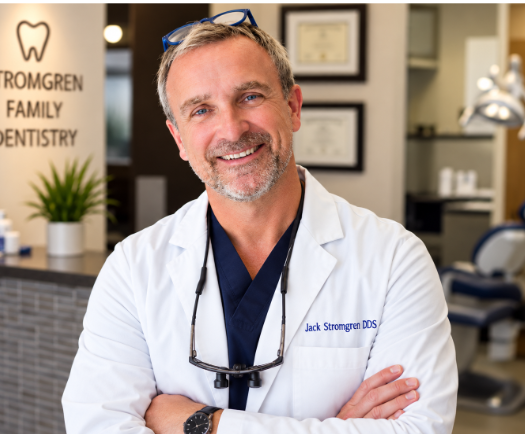
Jack Stromgren, DDS, a general dentist practicing in the Willow Glen neighborhood of San José, has developed a defined part of his clinical practice around this form of care.
What Oral Appliance Therapy Involves
Oral appliance therapy uses a custom-fitted dental device worn during sleep. The device holds the lower jaw in a position intended to help maintain an open airway. Unlike CPAP therapy, which delivers pressurized air through a mask, an oral appliance requires no external power source and is compact enough to travel with easily.
These devices are not one-size-fits-all. Fabrication requires dental impressions and a bite registration, followed by fitting and calibration to identify an appropriate therapeutic position. Follow-up appointments allow the dentist to evaluate comfort, device condition, and possible changes involving the teeth or jaw. Oral appliance therapy at Stromgren Family Dentistry is provided within this continuing care process rather than as a one-time device delivery.
Jack Stromgren’s Clinical Background in Sleep Apnea Care
Jack Stromgren earned his DDS from the University of California, San Francisco and completed a general practice residency at Santa Clara Valley Medical Center. When he acquired Stromgren Family Dentistry on Lincoln Avenue in Willow Glen in 2014, his clinical work centered primarily on restorative and implant dentistry.
Oral appliance therapy started at his practice incrementally. A patient with a documented sleep apnea diagnosis came to him because CPAP had not proved sustainable. That initial case led Stromgren to examine more closely the role a general dentist could play within a coordinated sleep apnea treatment plan. Over time, the service developed into a consistent part of the practice.
The Dentist’s Role in a Collaborative Care Model
Oral appliance therapy exists within a broader medical care structure. A medical provider diagnoses obstructive sleep apnea and determines the appropriate treatment direction. A dentist trained in oral appliance therapy evaluates the patient’s oral condition, selects and fits the device, calibrates it, and monitors its effects over time.
The distinction matters. The dentist does not replace the diagnosing physician or sleep specialist. The dental role centers on providing and managing the appliance, including examining the teeth, oral tissues, bite, and jaw before and during treatment. Follow-up sleep testing may be requested through the patient’s medical provider to evaluate the effectiveness of therapy.
Patient Considerations and Candidacy
Not every patient diagnosed with sleep apnea is an appropriate candidate for an oral appliance. Treatment decisions depend on the medical diagnosis, the prescribing provider’s recommendations, the patient’s oral condition, and whether a custom appliance can be fitted and retained properly.
Jack Stromgren’s Santa Clara County patients who inquire about oral appliance therapy undergo an evaluation that includes a review of existing diagnostic information, relevant health history, and dental and periodontal condition. The consultation also addresses what the treatment process involves and the follow-up required. Fitting and calibration may require multiple visits, and continuing monitoring remains part of care after the appliance is delivered.
Oral Appliance Therapy as Part of a General Dental Practice
Integrating sleep apnea care into a general dental practice requires clinical development specific to dental sleep medicine. The work sits at the intersection of dentistry and physician-directed sleep care, requiring the dentist to understand appliance selection, fitting, calibration, possible side effects, and long-term monitoring.
Dental visits can also provide an opportunity to discuss symptoms or concerns that may warrant evaluation by a medical provider. Dentists do not diagnose sleep apnea, but they can direct patients back to an appropriate physician when a medical assessment is needed. Stromgren Family Dentistry serves more than 3,000 active patients across Willow Glen and the broader San José area.
Fitting Oral Appliances: What the Process Looks Like
Once a medical diagnosis and treatment direction are established, the fabrication process begins with a dental examination, impressions of both arches, and a bite registration. A dental laboratory fabricates the device, which is then delivered and fitted at the practice.
Calibration continues through subsequent appointments as the patient and dentist assess comfort, fit, and the appliance’s therapeutic position. The dentist also monitors the condition of the device and any changes affecting the teeth, bite, or jaw. Follow-up testing through the patient’s medical provider may be used to evaluate treatment effectiveness.
The Broader Picture in Santa Clara County
Santa Clara County encompasses a large and demographically diverse population. Providing more than one recognized treatment option allows patients and their medical providers to consider which form of care is appropriate for the diagnosis, health history, and ability to use the prescribed therapy consistently.
The sleep apnea work of Jack Stromgren provides one local point of access for physician-directed oral appliance therapy. His Willow Glen practice contributes the dental component of care through patient evaluation, custom appliance fitting, calibration, and continuing monitoring.
Conclusion
Oral appliance therapy is a recognized option for appropriate adults with obstructive sleep apnea, including patients who cannot tolerate CPAP or prefer an alternative treatment. The dentist’s role is specific and clinical, centered on oral evaluation, device selection, precise fitting, calibration, and long-term monitoring within a collaborative care model.
For patients considering oral appliance therapy, the process begins with a medical diagnosis and a discussion with the appropriate healthcare providers about available treatment options.
About Jack Stromgren
Jack Stromgren is a general dentist and the owner of Stromgren Family Dentistry, located on Lincoln Avenue in the Willow Glen neighborhood of San José, California. He earned his DDS from the University of California, San Francisco and completed a general practice residency at Santa Clara Valley Medical Center. Since acquiring the practice in 2014, his clinical focus has included restorative and implant dentistry, oral appliance therapy for sleep apnea, and care for patients with dental anxiety. Stromgren Family Dentistry serves more than 3,000 active patients. Learn more about Jack Stromgren at Stromgren Family Dentistry and the services available through his San José practice.